Engagement of patients in health IT is getting more and more important these days. It was always necessary, but now this phenomenon has gained momentum in terms of importance as the modern physicians, medical practitioners as well as healthcare organizations are putting more emphasis on it. This is mainly because their financial success largely depends on the extent of patient involvement in health care IT.
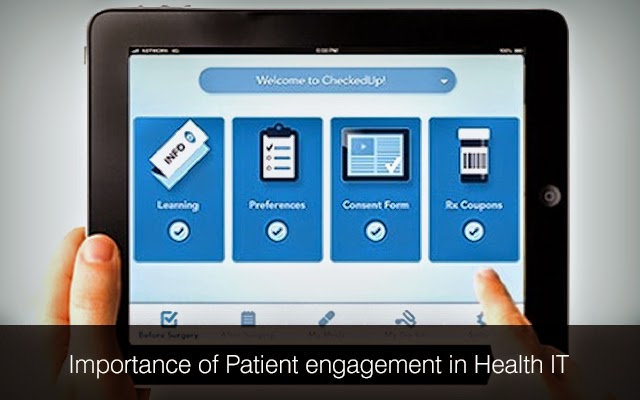 The concept can well be attributed to the importance it carries in today’s context. In fact, there have been a lot of top notch healthcare organizations that have been engaging their patients in health IT. Moreover, the emergence or introduction of new cutting edge technologies backed by the growing influence of more patient-centric approach in the delivery of treatment as well as care is making this phenomenon all the more important.
Let us see how an effective engagement of patients supports health care reforms and improves the expenditure related to treatment along with care.
Statistics say that effective involvement or engagement of patients in health care IT leads to significant cost saving as this enables the right kind of information to be delivered to the people subjected to treatment, thus leading to the much desired transparency in the entire system.
When there is no room for patient engagement, this leads to a gap in communication and patients may end up doing tests along with other stuffs that may not be needed, thereby increasing the cost unnecessarily. However, statistics clearly suggest that whenever people subjected to treatment are communicated with in a proper way regarding their conditions, they can understand and determine various options they have, to counter their medical condition. It is seen that in the majority of these cases, people take the less expensive yet effective paths.
It has also become apparent that the propagation of various internet-based mobile services and the ubiquity of the network connections that are available has made patient engagement in medical IT extremely easier than before and a substantial amount of people are now getting back to the healthcare service providers with valuable feedbacks which is making the task of these service providers easier so far as treating those patients is concerned.
So importance has been conferred to this engagement, that several health care service providers have even introduced mobile applications exclusively designed for patient feedback to ensure more and more patients get actively involved and engaged with the health IT service.
With a view to bridge up whatever communication gap there is between the service providers and the patients, newer technologies are being introduced. However, experts are of the opinion that before a patient actively starts getting engaged the individual at first needs to realize the extent of the effect it will have on the outcome or the diagnosis. Once this happens, then the involvement will be more effective at the end of the day, especially when it comes to treating any particular ailment and improving the relation between the service provider and the patient. After all, the very objectives of involvement of a patient in health IT is to improve the overall health of the patients, along with the relation between the two sides.
As the responsibility of the patients toward treatment costs increases, they have more ground to demand better convenience and more sophisticated solutions of engagement. Patients who do not get optimal satisfaction will have the chance to shift to another health care service provider.
Besides, providers who use various engagement solutions for patients like online portals are more efficient and are in a better position to properly respond to the needs of the patients resulting in better convenience.
Patient engagement in medical IT systems includes various portals that have substantially lowered the indirect as well as direct costs of practices, like mailing the costs for lab results, billing queries resolved via online instead of phone, online scheduling of appointments with doctors or online appointment reminders.
Both private as well as public insurance payers are now shifting to the performance-based reimbursement models when it comes to dealing with health insurance claims. Patient engagement in health care IT is hence extremely important for these value-based models of payment.
You can get in touch with healthcare software development companies for your clinical software development requirement. They can develop healthcare software within allocated budgets and time schedules.
If you would like to hire healthcare software developers, to We develop patient health portal for your healthcare organization, please get in touch with us at Mindfire Solutions.
Let us see how an effective engagement of patients supports health care reforms and improves the expenditure related to treatment along with care.
Statistics say that effective involvement or engagement of patients in health care IT leads to significant cost saving as this enables the right kind of information to be delivered to the people subjected to treatment, thus leading to the much desired transparency in the entire system.
When there is no room for patient engagement, this leads to a gap in communication and patients may end up doing tests along with other stuffs that may not be needed, thereby increasing the cost unnecessarily. However, statistics clearly suggest that whenever people subjected to treatment are communicated with in a proper way regarding their conditions, they can understand and determine various options they have, to counter their medical condition. It is seen that in the majority of these cases, people take the less expensive yet effective paths.
It has also become apparent that the propagation of various internet-based mobile services and the ubiquity of the network connections that are available has made patient engagement in medical IT extremely easier than before and a substantial amount of people are now getting back to the healthcare service providers with valuable feedbacks which is making the task of these service providers easier so far as treating those patients is concerned.
So importance has been conferred to this engagement, that several health care service providers have even introduced mobile applications exclusively designed for patient feedback to ensure more and more patients get actively involved and engaged with the health IT service.
With a view to bridge up whatever communication gap there is between the service providers and the patients, newer technologies are being introduced. However, experts are of the opinion that before a patient actively starts getting engaged the individual at first needs to realize the extent of the effect it will have on the outcome or the diagnosis. Once this happens, then the involvement will be more effective at the end of the day, especially when it comes to treating any particular ailment and improving the relation between the service provider and the patient. After all, the very objectives of involvement of a patient in health IT is to improve the overall health of the patients, along with the relation between the two sides.
As the responsibility of the patients toward treatment costs increases, they have more ground to demand better convenience and more sophisticated solutions of engagement. Patients who do not get optimal satisfaction will have the chance to shift to another health care service provider.
Besides, providers who use various engagement solutions for patients like online portals are more efficient and are in a better position to properly respond to the needs of the patients resulting in better convenience.
Patient engagement in medical IT systems includes various portals that have substantially lowered the indirect as well as direct costs of practices, like mailing the costs for lab results, billing queries resolved via online instead of phone, online scheduling of appointments with doctors or online appointment reminders.
Both private as well as public insurance payers are now shifting to the performance-based reimbursement models when it comes to dealing with health insurance claims. Patient engagement in health care IT is hence extremely important for these value-based models of payment.
You can get in touch with healthcare software development companies for your clinical software development requirement. They can develop healthcare software within allocated budgets and time schedules.
If you would like to hire healthcare software developers, to We develop patient health portal for your healthcare organization, please get in touch with us at Mindfire Solutions.

 That healthcare is changing at a fast pace is a reality all the stakeholders are coming to terms with. Irrespective of their preferences, they are left without a choice but to adapt. The transition taking place is evolving it from being proficiency-based art to a data-driven science. Physicians are shifting from being freelancers to being employed by hospitals. The delivery methods are changing from being one-size-fits-all community hospitals to vast hospital networks which are organized around centers of excellence. There is however, a certain level of criticism from the provider community towards this demand for change – almost to the extent of being reluctant to accept it. This could well be the result of their realization that the shift will finally result in better care outcomes for patient and less inflow of money for them. This is where the fraternity needs to take a step back and look at what lies at the core of their profession – that of helping people overcome their health related ailments. One cannot deny the fact that the profession has a certain degree of nobility attached to it. As much as it is important for physicians to gain financially, the overriding factor which draws people to take up this profession is expected to be a deep desire to serve humanity by curing people of their health related problems. Infact the ones who have realized it and connect to it are eagerly looking forward to days where they would have satisfied patients with lower expenses and they would be proud of their work. The tension which now exists between patients and physicians does not please the majority of the people in the profession and they would expect the new model to give way to trust and happiness for the providers. This is not to say that physicians are expected to lead lives of monks with no desire to gain financially from their services but to let money play the most important role in the system would be going against the core tenets of the profession.