Showing posts with label sharepoint portal development. Show all posts

09 January, 2014

SharePoint - A Precious Business Tool

One of the most successful platforms for any business enterprise in today's time is SharePoint. It is creative by nature as it provides enhanced productivity with long lasting collaboration to business owners across varied needs. The latest versions’ launch of shareware has proved Why SharePoint is considered as precious business tool, since it is very appealing and user friendly, say experts.

SharePoint development
Icing on the cake using this platform is that the service deliverables it brings along would be excellent as well as highly efficient. It helps with collaboration that makes businesses run smooth along with functioning ethics that are fabulous to say so. Share-point with its latest version has gained more happy users than ever before. This is because; clients now can use the platform to send large reports along with data across in a jiffy, which is so important for business needs or business expansion these days.

The wait is over
Gone are the days when other platforms took a century almost to transfer large files as well as data. The suite SharePoint now does it all in no time. The anticipation and wait is over, SharePoint now is being looked at as manna from the heavenly technological world, or should we say an answer to all large data transfer needs. The updates have excited users, and customers are exploring the major changes in the platform like never before. Unlike its predecessor, the SharePoint version launched this year has features and functions that offer the best, plus more support for options such as;

a. BI
b. Search
c. Mobile support
d. Public Website Support
e. Mobile as well as social sharing

Business wise intelligent
Companies need to be smart and for that SharePoint is used to the rescue, or else perishing in the deep business oceans would be the fate. Analysis or insights given by the latest version of SharePoint are unmatched and of high quality. Excel as well as SharePoint are tightly integrated, performance wise, say sources.

Businesses run not only through browsers on the computer but also through the phone as well, hence SharePoint allows such features which would help users use desktop apps on any smart device as well, irrespective of the size of the screen. Mobile browsing options come in;

a. Contemporary view
b. Classic view
c. Full screen (UI)
In addition to that, customers now also have efficiency with geo-location in the form of push notification services, which can be used on tablets and smart devices like never before.

Socialising made easy and plenty more reasons to be happy
There are newer features for socialising offered by the latest version of SharePoint. Newsfeed, community sites, sharing, collaborating as well as knowledge transfer and more, all of which the latest version of the platform has brought for everyone to use, and businesses are making the most using them all.

Even the search options have been optimised so well that the results are relevant and to the point, hence no more scourging around for an answer. Laymen and IT users are the happiest with such new features, especially when they can customise appearances based on the type of content than the history that was being looked for.

Another feature which has caught the eye and fancy of users with the latest version of SharePoint is the eDiscovery function; it has a range of new tools that manages discovering like never before. This in fact is wonderful for business owners; since it helps them stay protected while the centre searches across SharePoint, Lync or Exchange for content that has been preserved or exported.

Finally, with the latest version of SharePoint in place, companies now can have public facing sites or even internal intranet sites using pixel perfect schemes for branding. It used to be a complicated task achieving the same in the past, but with the latest in SharePoint and its tools, things are now done in a jiffy. One doesn’t need a lot of internal support for the same, expenses too would be the least and the designs are a wide variety to choose from, say experts.

Make your dreams come true by expanding your businesses like never before. Let the large files or data not worry you anymore! Hire developers from top SharePoint development companies after due diligence and they would help you develop SharePoint applications within allocated budget and time schedules.

We provide custom SharePoint development services. If you would like to know more about the expertise of our expert SharePoint developers, please get in touch with us at Mindfire Solutions.


01 November, 2013

10 Tips for Making Your SharePoint Project a Success

While SharePoint, as an advanced web application development platform, has become widely used for its many benefits, several organizations fail to emerge successful with a SharePoint project. So, prior to looking into the tips on making SharePoint project a success, here is what one should avoid doing at the time of implementation of SP.

Mistakes to Avoid in SP Project Implementation
  • Trying to accomplish too many tasks within very less time is one of the common mistakes committed by enterprises. It needs to be realized by the stakeholders as well that the specific needs will be catered to and fulfilled in future if not right now.
  • Point searching several websites that are quite large is a mistake for the reason that there is no possible way of limiting the volume of data in the search catalogs of SP. As a result, SP will simply index numerous pages while also bringing the server down.
  • The attempt at doing everything including delivering projects in house leads to a failed outcome. Unless the enterprise has quite a large team, emerging successful with a SharePoint project is but a rare possibility.
  • Allowing any one individual to exercise complete control of permissions is a blunder. This is because users with full permission can take certain wrong steps such as adding a lot of content, deleting sites, giving inappropriate permissions and so on.
Tips on Enjoying a Successful SharePoint Project

SharePoint application developmentOnce you are aware of the things to be avoided, it is time to concentrate on few tips or strategies, applying which paves the way for an effective SharePoint project. Here is a list of these:
1. Making Use of Standard Functionality

Configuration is always preferred over coding. SharePoint is immensely powerful and mistaking it for just a .NET application should be avoided. As such, spending on other resources instead of spending too much on coding makes it easier to support as well as upgrade the site.

2. Understanding the Technology

Understanding SharePoint thoroughly is essential in the very first place. One should gain the basic knowledge of SP in order to be able to not just deploy it in the desired manner but also encounter the issues, as and when they arise.

3. Empowering the Users and Delegates

When it comes to executing a SharePoint project with success, one must not be apprehensive of handing down the rights to create sites or author content and so on. Alongside, use of publishing control, version control along with workflows to adhere to quality and policy of the organization should also be facilitated.

4. Focusing on Simple Visual Designs

With respect to the SharePoint user interface, more emphasis should be laid on the functionality of the site instead of its looks. Let the designers know what matters most for a SharePoint site from the very beginning, as customizing it later might appear to be a rather tough task.

5. Never Planning for the End

This might appear to be rather tricky but it has to be remembered that a project in SP, unlike others, does not end but expands with the growth of the business. What is necessary is to take an interactive approach and let users understand as well as contribute to the process of repeating till the desired goal is achieved.

6. Managing Expectations Arising from Different Quarters

Every SP project will essentially begin with two figures set as goal, one of cost and the other of delivery date. One must always stay careful about managing the expectations of the senior managers by means of giving them high level costs as well as timescales.

7. Allowing the Permission Model to Stay Simple

The permission model, especially the structures, should be kept as simple as possible. Building complex structures implies managing too much in return of too less a value.

8. Choosing the Partner Carefully

It is more than necessary to have a partner, who understands both the technology as well as the NHS. Partners should be the ones you can trust no matter how much you test or challenge them. Mutual advice and cooperation paves the way for appreciable results.

9. Convince Even the Rather Stubborn Customers

The best way of engaging the stubborn customers are by considering and appreciating their requirements as well as ideas. It has to be remembered in this respect that the stubborn ones are also the most vocal ones and hence, they can turn out to be the real assets for an enterprise.

10. Be Ready to Take Risks

As the saying goes, 'No risk, no gain', it is always good to take risks than stay back in apprehension. Try out varying strategies and trust the users enough to gain the desired success in the usage of SharePoint.

Implementing the 10 points suggested above greatly amplifies the chances of getting successful with SharePoint application development, leading to the benefit of the enterprises.

We provide custom Sharepoint development services. If you would like to know more about the expertise of our SharePoint developers, please get in touch with us at Mindfire Solutions.

31 October, 2013

SharePoint End-User Adoption and Productivity List

SharePoint has undoubtedly emerged as one of the best web application development platforms that is being implemented by enterprises all over. Now, attempts are constantly being made to improve the user adoption and productivity of the SharePoint 2013. There are a number of tools, techniques and methods that are implemented for making SP more user- friendly as well as productive.

Enhancing the Level of User Adoption

Before looking into some tips on how the productivity can be increased, let us begin with a discussion of the different stages of user adoption as follows:

Collaboration of Documents
SharePoint application developmentDocument Collaboration is the very first and the most basic way of letting users adopt SP 2013 with higher level of effectiveness. With SharePoint, document sharing does not stay restricted to sending emails back and forth but extend much beyond that to include check in/out, alerts, versioning and so on. The integration with Office further paves the way for a direct opening of the files from the Office programs.

A Single Focal Point or Team Sites
It is always more comfortable for the users if they get the chance to reach a certain point where they are making regular use of this platform. While trying as well as exploring certain new things, users become friendly with the concept of team site. Calenders can be shared, tasks can be assigned while contact lists can be created for proper referencing. Connection among each other through Outlook makes SP more productive.

Coordinating Business Processes
When the users are able to keep in touch by virtue of the team sites, they engage in the task of automating business processes. Using the workflows is indeed an elaborate task with multiple processes that need to be taken care of. Now, irrespective of the numbers of processes or the complications involved in the same, it is always easy when the processes are automated.

Reporting with SharePoint 2013
For organizations that are pretty much advanced with regards to SP implementation, reporting is quite hassle-free. The application of the tools should be followed by an understanding of the placement of the data to ensure that the best-suited tools are used. As far as the end users are concerned, there are different products along with equally varying ways that can be presented. SharePoint is deployed as the primary means to presenting these reports. The level of user adoption is automatically higher with SP being used for both document collaboration as well as reporting.

Social Media Adoption
The good thing about Microsoft SharePoint 2013 is that the social features and functionality are available everywhere. Even today, few organizations are found considering the social part of SharePoint 2013 even after they have become rather experienced in SP use and knowledge. At the same time, there are organizations that implement social media as a significant part of their use of SP and they actually benefit from it. However, integration of the social media and SharePoint must take place following a carefully planned process.

Tips on Increasing Productivity
The successful deployment of SharePoint 2013 can be gauged from the increase in the overall productivity. There are certain strategies that can be adopted to ensure that the implementation of SP has a direct influence upon the productivity.
  • The end-user requirements should be taken into consideration in designing an interface that maximizes productivity. The site aesthetics matter to a great extent. For instance, branding of the SP intranet implies that users should seriously consider it along with its use.
  • Training is must to let users get the most out of an application. Awareness about the functional requirements as well as that of the not so professional or specialized areas goes a long way in increasing productivity.
  • Performance happens to be more important than a lot of other things. Increased emphasis should be laid on improving the load time of the pages, accelerating the upload and download time of files and making sure that the servers work well enough to cater to high demand.
The above-mentioned list of stages and tips helps improving end-user adoption and productivity of SP 2013. And that is equally as important as optimizing the process of SharePoint application development.

We provide Sharepoint development services. If you would like to know more about the expertise of our SharePoint developers, please get in touch with us at Mindfire Solutions.

17 October, 2013

5 ways to spruce up SharePoint 2013 for your intranet CMS

One of the biggest drawbacks that affect content management is the lack of proper search plug-ins. In the current scenario, businesses do not have adequate amount of time for tracking down different files. SharePoint comes to rescue in such a situation.

SharePoint developer
SharePoint intranet comes with convenient document libraries, enabling every business to categorize information in the way they want. In fact, you can have all your content easily accessible by means of different libraries within a hosted portal- a library for media, one for finance, report, sales, marketing and so on. The inconvenience of lost data will never be experienced. The intranet also comprises the latest antiviral software for ensuring preservation of online infrastructure.

As a business owner or team member, SP allows you to open up documents through the web, and also to synchronize work via document collaboration. In short, SharePoint provides a collaborative, hosted solution for content management through the intranet. Investing in SharePoint development for org-wide collaboration always pays rich dividends. Let us discuss 5 trending ways which will help you to spruce up SharePoint 2013 for your intranet CMS.

1. Creation of an intranet newsfeed with SP 2013
With the help of an intranet newsfeed, users are able to publicly and rapidly communicate with each other by sharing ideas, posting updates, asking questions along with other activities. So far as the management is concerned, it is a great means for engaging with employees personally, directly and openly. Moreover, the SharePoint newsfeed renders a micro-blogging experience similar to that derived from social media platforms like Facebook and Twitter. Users are able to post comments, direct particular users with the help of @targeting as well as tag the same to a particular topic utilizing #tags. Comments or users can be liked or followed.

2. Showcasing intranet blogs with SP 2013
Intranet blogs are a brilliant way to discuss on relevant topics providing authors with the capability of communicating a message as well as starting conversation and collecting feedback. Readers can have their opinions heard and addressed. Authoring and publishing tools are offered by the SharePoint blog site to authors, in the same manner as they would expect from a consumer CMS. The features include the ability of video embedding from sources such as YouTube, rich text editing, capability of content publishing directly from MS Word. It is possible to like, rate, follow or share blog posts.

3. Using SharePoint 2013 for creation of intranet survey
With the help of intranet surveys, creators are able to speedily crowd source precious information from a huge employee pool. As participants, employees can get an easy means for bottom-up feedback and hence become more engaged. The SharePoint survey app offers a template to easily as well as quickly build surveys with diverse question types (multiple choice, text fields, rating scales). On completion of the surveys, results are represented graphically with the facility of exporting to Excel. The promoted links app of SharePoint builds metro-style tiles along with a hover-over state in order to make room for additional text information. The advantage is that tiles offer increasing visual engagement as against a standard list, following the SP site's theme.

4. Leveraging SP 2013 for surfacing intranet KPIs
With regular and convenient access to KPIs, employees can adjust their activities to accommodate the changing business demands. Enhanced visibility of performance metrics at an organizational level helps in greater employee collaboration. With the help of the Excel Web Access Web Part, data can be displayed from an Excel spreadsheet straightaway onto a SharePoint page. Granular control can be maintained by the author over the data that can be displayed from the spreadsheet and accessed. Once it surfaces on the SP page, the data can be made user-interactive.

5. Using SharePoint 2013 for creation of an intranet discussion list
Through intranet discussion lists, users can discuss specific topics with subject matter experts and their peers. It can be used for diverse purposes helping employees draw the benefits of a wide organizational network of resources and knowledge. Forum-style collaboration areas can be created with the help of SP Community Site Features. Using the discussion list, users can start discussions or ask questions. Moreover, categorization of the content can be done.

For creating an engaging and dynamic intranet CMS, SharePoint 2013 is loaded with all the requisite functionality. Great outcomes can be enjoyed by those who comprehend the changing intranet demands and leverage this new functionality.

We provide SharePoint application development services. If you would like to discuss with an expert SharePoint developer from our team, please get in touch with us at Mindfire Solutions.

16 October, 2013

How To Control App Token Lifetimes in SharePoint 2013?

SharePoint has emerged to be one of the most beneficial web application development platforms these days. The newer versions of this platform have turned out to be of immense use for the business enterprises as, they assist in the successful accomplishment of several tasks and necessitate much less time and efforts. Now, developers are trying out more innovative ways of exploiting SharePoint so as to derive the maximum advantages out of this already useful platform. Controlling the app token lifetimes in SP 2013 is one area of concern that is emphasized upon to a significant extent.

SharePoint development companies
The first question that arises in this regard is where one can control the app token lifetimes. However, when considered on a broader platform, it will be seen that the place of control is actually not so significant and that a highly advanced app like TokenHelper can be of substantial help. There are around one or two JWT tokens that are created if one goes by the IssueToken method. It is usually one when the app only token is being used and two tokens for the application and the current user. However, in both the events, the JsonWebSecurityToken is created and the parameter that is used to create the same determines as to how long it is valid.

It is for the app token that the TokenHelper makes use of a constant, which is known as TokenLifeTimeMinutes. By default, this constant has a value of 1,000,000, which leaves no scope of worrying except in cases where one wants to limit it. Now, for the user token, the constant is hard- coded by default for making use of a lifetime of 10 minutes. The values can be found as well as changed into whatever you want just with a little drilling into the IssueToken method.

With a deeper look into the code, it can be seen that the TokenHelper incorporates a delegate that is invoked in what is known as the GetClientContextWithAccessToken method. This method plays the important role in adding a bearer token to any particular request that comes into the SharePoint from the particular app of the user.

Now, if the user sets a breakpoint on that specific line of code and eventually step through the request from the app, none of the token 'setup' functions creating the ClientContext will be resulting in an HTTP call. At this point, the ExecuteQuery method has to be called on the ClientContext object. The request goes over the wire, the delegate fires and finally, the token is added to the request. While one can cache the access token obtained in the high trust app, there may not always be a justified reason behind doing so.

On the other hand, caching the app tokens is beneficial only at the time of using the relatively low trust apps. When such is the case, one has to save one or more trips to ACS for the purpose of accessing token at the time of caching them. In events where there are multiple users or several requests, the process helps. The only thing that one needs to be aware of in this regard is the right ways of caching the tokens for the low trust apps.

This is just a brief overview of the overall process of controlling application lifetimes in SharePoint 2013 along with a discussion about the use and benefits of the high trust as well as the low trust apps. However, it is a task that needs to be taken up by only the experts and pros in the field, who are aware of the processes and can therefore, adept in handling the same to produce faster results in less time.

You can hire developers from top SharePoint development companies in India who can help you build products within allocated budgets and time schedules.

We provide SharePoint CMS customization services. If you would like to know more about the expertise of our SharePoint developers, please get in touch with us at Mindfire Solutions.

30 September, 2013

Office 365 SharePoint Online File Migration Tool - A detailed overview

SharePoint online migration is not something that can be easily achieved; rather, it engages careful planning for successful execution of the same. The reason is simple, you need to deal with a huge volume of important data and no sort of downtime is usually tolerated by an organization. Therefore, the biggest question that crops up in such situation is how to avoid the risk of losing any data ensuring an exact move of just the elements you need alongside involving minimum time possible reducing the impact upon the users along with the systems?

Well, the solution rests with an online file migration tool. This particular tool is an online adaptation of the SharePoint server based on the new as well as latest technology of SaaS (Software As a Service). Migrating might come across as an expensive alongside a complex task, but with little software investment, you can actually get working smoothly. The tool allows you to experience a hassle free migration of Exchange to Office 365 SharePoint, Lotus Notes to Office 365 SharePoint Online, and File System to Office 365 SharePoint.

Exploring the World of Effortless Office 365 Migration
Migrating SharePoint Online is sure to come across as an effortless solution as the migrating software is not only reliable, but also fail – safe. This particular tool or software has been developed following a process of intensive testing. It has been passed fail-safe following strict rounds of analysis by expert developers and quality analysts. Therefore, there hardly stands any chance of the software going wrong during the process of executing a successful migration.

Whether the need is focused on migration of File System, Public Folder, or Lotus Notes to Office 365, you can do it all with the help of this versatile tool. After all, the task of manually copying files from multiple resources like file servers, network shares, and network drives to SharePoint Online is a challenging task. The task, especially gets difficult when there are several things to migrate as it not only gets time consuming, but also prone to errors.

A single error in the copy can interrupt as well as restrict the flow of entire switch. Additionally, you also need to keep in mind the several characters alongside the file types that SharePoint Online tends to decline at a go. A proper migrating tool helps solve all such difficulties as well as the issues that are usually faced while migrating manually. Usually, the software stands in compliance to the standards of naming a file in SharePoint Online and therefore helps save both your time as well as effort during migration.

A Look at the Features

Here is a quick look at the features that make the file migration tool stand apart from the rest alternatives as well as choices in respect to SharePoint Online:
  • Compatible with Midsize Business, Small Business, Education, and Enterprise plans
  • Allows automatic rename of files featuring characters that are usually denied
  • Flexible to all sorts of network interruptions that crop up for temporary period
  • Enables automatic zip of files featuring file extensions that are rejected
  • Helps in the identification of files featuring big file sizes and file paths that are too lengthy
  • Facilitates the copy of only changed files when the migration is resumed again
  • Keeps a track of the original date of modification of the files
  • Provides a complete and comprehensive audit trail of every migrated file
  • Handles documents check-ins and checkouts automatically for libraries requiring the same
  • Allows automatic re-authentication for migrations that are lengthy
The file migration tool is sure to help you leverage your business growth instantly. Prior to investing in the software, you can run a demo and see whether it suits your business approach perfectly. To ensure successful migration, you can invest in the complete software and experience better business.

You can hire developers from top companies in SharePoint who can help you build apps within allocated budgets and time schedules.

We provide SharePoint 2010 development services. If you would like to talk to one of our certified SharePoint programmers, please get in touch with us at Mindfire Solutions.

29 September, 2013

9 Tips to Integrate DotNetNuke with SharePoint

If you need to develop an engaging as well as interesting website featuring optimum and advanced tools until date, the choice undeniably rests with DotNetNuke (DNN). With businesses facing diverse challenges in terms of content modification, DNN offering multiple solutions addressing the various technological needs of the content providers and emerging interests of the people comes to right help.

Why is DNN unique and a preferred choice?
SharePoint development companiesThe reason is simple; DNN offering a wide range of tools supports the rapidly changing consumer as well as technology trends thereby, enabling users to move forward without any difficulty. Being the world’s number one WCMS for Microsoft, DotNetNuke stands as the most successful and largest open-source CMS plug-in catering to the Microsoft ecosystem. This particular software is extraordinarily empowered to offer virtual help to any enterprise for approaching or facing architectural challenges from every angle. The platform also helps the nonprofit organization to save both time as well as money.

What brings SharePoint to the forefront?
SharePoint is a pioneer in providing intranet solution geared towards efficient handling of internal document management, which includes but is not restricted to sharing, editing, and uploading of reports along with contents. In simpler terms, this particular application ensures easy access of data by everybody in the business network. It streamlines the complex process of collaborating along with managing the important business documents. This particular application is actually incorporated by anybody managing content starting from business to nonprofit organizations. The SharePoint and DNN connector further ensures complete optimization of the process and has been successfully integrated by businesses across different sectors.

To ensure complete optimization of the content creation, business organizations as well as enterprises need to execute a successful integration of DNN with SharePoint.

Integrating DotNetNuke with SharePoint – Tips to Follow

Here is a quick look at the tips that you need to remember while integrating the DNN software successfully with the SharePoint application:

1. Good knowledge of SharePoint and DotNetNuke – This particular approach helps in easy as well as seamless integration of both the document management system and the software making it easy for content monitoring along with modification. It is important to have good knowledge of the software as well as the application before taking up integration.

2. Always integrate with SharePoint 2007 and 2010 – This particular objective helps you enjoy the best benefits of both the DotNetNuke along with the document management system. After all, it helps publishing fresh contents extracting it straight from the SharePoint Document library. The published documents are carefully protected by the role based security network of DNN.

3. Always publish documents that are approved for display – Undertaking this particular approach always helps you to avoid any sort of interference with the team. This helps you ensure the use of a streamlined alongside a collaborative procedure that helps in effective management of the document. Additionally, it also allows you to share the best documents that are carefully edited and ready for use.

4. Ensure consistent permission throughout the work – This particular objective if maintained right helps preventing any sort of unauthorized access thereby, ensuring a secure digital asset management. Additionally, it also helps preventing the redistribution of assets that are digital.

5. Make use of views and not folders – This helps you ensure having unlimited flexibility along with extreme level of granularity. It is also important for you to be able to combine the properties easily and this particular approach helps in successful combination. The biggest advantage rests with the fact that it helps reducing overall risk alongside human error.

6. Synchronize the deletes – Taking up this particular approaching during the process of integration also helps avoiding the errors of “file not found” during the successful execution of removal of files. This particular approach of cleaning also ensures reduction of unimportant database clogging, duplication, overall risk, and human errors.

7. Enabling of error notification is must – This specific task helps in automatic synchronization eliminating the need of active viewing or monitoring of the document in concern. This result in a smooth process that helps you to lessen the effort along with the time required for content monitoring.

8. Avoid the firewall – Always make sure that the SharePoint server can enjoy an easy access to the DOTNetNuke server. This helps in smoother as well as better content management without any modification of security policies.

9. Allow filtering of documents to be transferred – This particular approach helps the users to filter the documents easily through the integrated SharePoint filtering views. This helps the users to make use of the Create View UI and need not rely upon two different sets of filters.

Following the above-mentioned tips is sure to help you achieve a successful integration of DotNetNuke with SharePoint and ensure defining the success metrics for your organization in terms of less error, reduced publishing time, etc.

You can hire developers from top sharepoint development companies in india who can help you build apps within allocated budgets and time schedules.

We provide SharePoint portal development services. If you would like to talk to one of our certified SharePoint developers, please get in touch with us at Mindfire Solutions.

23 September, 2013

Steps to create a SharePoint 2013 App with Ruby on Rails

The SharePoint model is quite new to everybody and the recent launch of the 2013 version had made it even more ambiguous to developers around the world. Now, when it comes to creating an application pertaining to the software with Ruby on Rails, most developers seem to have a tough time in embracing the appropriate approach. Well, here is a guide for all Rails developers looking forward to creating an app successfully on the particular framework. However, please note that this particular guide should never be used as the best practice of Ruby on Rails development.

SharePoint portal development
Well, before beginning the process, you must register a new application in Office 365. Ensure that a Site Collection has been created by making use of the Developer Site Template. This can be done from the Office 365 admin screens. Following the creation of the same, browse site collection and register the SharePoint application with Office 365 as well as Azure Access Control Services (ACS). For any sort of development purpose, the registration of the new app can be easily done through appregnew.aspx page present within Office 365. Since there is no such link available for the actual page, you need browse the URL directly.

Always remember that since the registration of the application is done through appregnew.aspx, the secret of the particular app will only be known by the ACS and you. Therefore, the series of characters that will be generated will be specifically used for decoding information coming from ACS/SharePoint. Always make sure to take note of the id of the app, as you will not be having any access of the same again.

Since the application will be only used for testing and development purposes, registering it through appregnew.aspx comes across as a wise choice. If there arises a need of making the app thoroughly and widely available or list in the official store of SharePoint, then an account must be registered at the Seller Dashboard.

1. Visual Studio

The next step of work rests with Visual Studio where an application package must be created, which would eventually be uploaded to SharePoint. To make this happen, you need to follow the following steps:
  • Open Visual Studio (through 'Run as Administrator') for creating a new project. Go for project creation using the template ‘App for SharePoint 2013’. You will find this under the SharePoint /Office project node.
  • Following this, you will be asked about the type of SharePoint app that you would like to create. Always remember to offer your app a similar name to that you have given in the appregnew.aspx and submit the URL of the Developer site collection. Ensure choosing an application type of Provider – hosted as the hosting model.
  • In the last screen, leave the top option by selecting ‘Use a client secret’. Once, you click on the button OK, you will get to see the creation of 2 projects in Solution Explorer.
  • It is to be noted that the first project usually implies to the SharePoint App that generates the application package. This particular app will be uploaded.
  • The following step requires you to double click AppManifest.xml that consists of all the details related to the app. Upon opening the Manifest Designer, you need to remember to insert some specific values.
Always remember that the application needs to take permissions for being able to read and write data to the SharePoint site where the application is installed. This can be easily done through the permission tab. All you need to do is request just the permission that is actually needed. Always note that the more permission the app would request, the more it will run the risk of not being installed as users will be concerned about the security risk. Always remember to save and then close the AppManifest designer.

2. Ruby on Rails and Apple MacOS

To be able to work with SharePoint 2013, there stands a requirement of installing Ruby Gems to make things easier. Here is a look at the needs:
  • jwt – this helps in decoding the JSON web token that emerges from the application software
  • rest-client – this enables placing rest requests
  • nokogiri – a library that helps querying XML that is usually returned from the SharePoint
the next step of action lies in creating a new application based on Ruby on Rails in your preferred code folder. All you need to do is type into Terminal. Rails is now ready for getting a MVC web application.

Open the gemfile and under the gem stated as ‘jquery-rails’, integrate the gems that were downloaded as pre-reqs.
  • gem ‘jwt’
  • gem ‘rest-client’
  • gem ‘nokogiri’
This particular step is quite similar to the task of adding new reference in Visual Studio assembly.

3. Https Configuration

You must have noticed that while registering the application in appregnew.aspx, a Redirect URL is set that is https://localhost:3001. The app will be making use of the OAuth for being able to authorize the user and the application. Remember, that the for ensuring OAuth specification, both ends of communication must be https. After all, you would definitely not want any poor interception of unencrypted tokens to be transmitted over the Internet and have an access to the Office 365 or SharePoint site. Rails usually make use of WEBric, which is developed in web server. This is quite similar to the IISExpress of the Visual Studio.

To get the SharePoint 2013 mobile development right, you would have to follow the steps above. Then hopefully, you will be able to successfully create a SharePoint app with Ruby on Rails.

We provide SharePoint portal development services. If you would like to know more about the expertise of our expert SharePoint developers, please get in touch with us at Mindfire Solutions.

20 September, 2013

Tips for Integrating SharePoint data with Java Applications

A number of enterprises today are looking forward to integrating content from the SharePoint site with java applications. Such organizations are usually considering avenues to deliver an integrated and optimized experience for the end user across a range of software platforms. In addition, the endeavor is also directed towards the aim of bringing the SharePoint data into compliance with governance, security, and branding standards. Net result, SharePoint application development and data migration is heading northwards.

SharePoint developers
Now, when it comes to integrating, the same can be achieved through the different tools or SharePoint integrator offering maximum competency and comprehensiveness. The software usually enhances the ability of the portal to take up an all-encompassing job that combines all assets of the enterprise together with the SharePoint content like the java applications with a scalable and saleable environment.

In today’s present age, the dominance of SharePoint is indomitable. The particular document management system application is today found everywhere and is rapidly used across enterprises. However, the challenge comes when enterprises need to integrate the SharePoint data with Java applications. Well, it is to be noted that the integration does not come easy and the organizations need to depend on a number of considerations for achieving the best.

If you seem to be wondering about the factors, then here is a look at the aspects of dependency that helps achieving optimal integration of the software with the web application –
  • The particular version of Java that is being used
  • The version of SharePoint that is being employed for the purpose
  • The level of integration that is actually needed for the enterprise
Let’s assume the use of SharePoint 2007 and Java 1.5 for the integration exercise (the usual scenario that crops up while integrating existing applications of Java to new services of the document management system application).

Now, it is to be noted that it is quite difficult to determine the end of the particular approach. However, one of the major objectives of the integration approach rests with the fact of producing a matrix of the accurate approach of use across the various versions of Java and SharePoint.

Principle requirements
The principle requirements that must be followed while taking up the approach are as follows:
  • Support for authentication schemes for IIS
  • Support for the protocols of remote access
  • Support for an integration up to highest level possible
  • Integration based on LAN
Access Options of SharePoint Service Well, fortunately the products pertaining to SharePoint feature a number of access options that are entirely service based and dependent on the particular version. However, you need to keep in mind that the previous versions usually featured less capabilities based on the interfaces. Therefore, you must always have a look at the specific capabilities of need prior to making any choice.

Java Choices
The options of integration vary greatly depending on the particular version of the Java that is being used:
  • Java 1.4 : The 1.4 version of the web application offers a restricted support for services based on the document management system application that exists in the distribution base. While a number of possible frameworks pertaining to Java web services can be used, the Axis 2 offers a special support to the NTLM V1 catering to all the requirements. Additionally, a primary consideration rests with support for the authentication schemes IIS. The base distribution features XML – RPC support
  • Java 1.5 : The 1.5 version of the Java platform offers complete support for web services based on the document management system as well as the XML- RPC interface.
  • Java 6 : This particular version offers complete support to the XML-RPC and web services that are available in the base distribution as well as supports an authentication of NTLM V1.
We provide custom SharePoint development services. If you would like to know more about the expertise of our expert SharePoint developers, please get in touch with us at Mindfire Solutions.

16 September, 2013

Integrating ColdFusion Applications with Microsoft SharePoint

While ColdFusion is recognized as a much preferred programming platform, the recent trend is that of integrating it with Microsoft SharePoint. Why? Because SharePoint bespoke development helps create most personalized web products which greatly enhance the efficiency of operations in an enterprise. The latest version of the former platform, that is ColdFusion 9, will feature this integration. However, before going into the details of how this integration can be executed or the possible benefits of the process, let us understand few basics about SharePoint.

SharePoint bespoke developmentBasically a content management system at its best, SharePoint is an application that helps in accessing data stored in the MSSQL database. The integrated search services facilitated by it help in adding team collaboration context to the management of the data files, generated by the Microsoft Office Suite. When it comes to SharePoint, the site hierarchy and the permission- based roles become important. The key permission levels allow users to read, contribute, design as well as take full control of the SharePoint sites along with data after a certain stage.

With regards to the integration, the most important requirement is to understand the precise needs of the users. ColdFusion 9 incorporates the integration feature to solve most of the problems of a majority of users and not to satisfy only a handful of them.

Single-Sign-On Support
The demand for a single-sign-on (SSO) support is the most common of all requirements. This support would allow the ColdFusion applications working under SharePoint increase the level of the platform’s authenticity as well as security by means of removing the necessity of logins and authentication of the ColdFusion applications. Now, with ColdFusion 9, the task becomes easier as a result of an inclusion of the SharePoint integration files in ColdFusion. The installation and configuration of these files paves the way for the platform to invoke applications offering SSO support.

ColdFusion Applications
The concept of the platform applications running the Microsoft SharePoint platform might appear to be a little confusing. Web Parts and ASP.Net server controls are used to build the applications. The Web Parts can actually be pre- written in the controls provided by Microsoft, 3rd party controls as well as the individual controls. With ColdFusion 9 applications and the SSO support, necessary grounds for the perfect integration are ready.

Web Parts
Users might simply want to access data in the platform and may not be looking for running application as a Web Part. There are many who use the platform with the intention of deriving benefits out of user lists, views and groups, use the platform search option or work with the stored images and document workspaces. All these activities can be done with the help of exposed web services. However, a new tag is made available for maximum control as well as higher level of performance.

The Cfsharepoint Tag
The cfsharepoint tag is a powerful one, enabling manipulation of SharePoint by virtue of its several attributes. It facilitates around 50 actions. The tag can actually make the platform do anything. All that one needs to do is pass the credentials in a structured manner or supply the values individually in the form of domain, password and username values. The credentials must be stored in the Application.cfcfile.

An integration of ColdFusion with Microsoft SharePoint encompasses SSO, platform applications, Web Parts, SharePoint services along with the cfsharepoint tag. With these, the requirements of the users are catered in an effective manner while the incorporation of ColdFusion as an important part of an enterprise is also realized. The integration increases the power and productivity of the platform to great heights. Thus, seen from all respects, the merging of the two popular and prominent web application development platforms is of immense use for the experienced developers as well as that for the enterprises.

We provide Coldfusion Sharepoint Integration services. If you would like to know more about the expertise of our expert certified sharepoint developers, please get in touch with us at Mindfire Solutions.

15 September, 2013

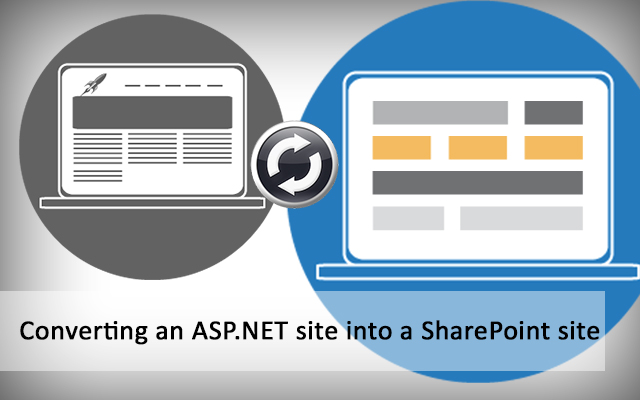
Converting an ASP.NET site into a SharePoint site - Top 7 Issues faced and their solutions

SharePoint has become increasingly popular nowadays. A plethora of web projects are directly started in SharePoint. But still there are a lot many projects which remain out of the SharePoint scope and exist purely in the form of ASP.NET application.

SharePoint application developmentA common task that becomes applicable during migration of an existing ASP site to a SharePoint site is transforming the landing page of the site to SharePoint page. That is where the problem starts. So far as .NET applications are concerned, they incorporate diverse modern technologies and tools such as URL Rewriting, SilverLight, MVC and so on. These tools are extremely common when it comes to .NET development. However, they can pose potential problems in the world of SharePoint. Let us discuss some of the issues faced in conversion of a .NET site into a SharePoint site.

1. Master.page: SP does not support the AutoEventWireup=”true” attribute on every page. So it is good to remove the same. Moreover, there is no support for user controls on master.page, so they can be moved to CONTROLTEMPLATES folder and references need to be changed. All classes from where inheritance takes place should have namespaces.

2. CSS: SP does not render 100% CSS validation. In this case, it is good to go for CSS customization and debugging, wherein you would be getting a clean CSS file. In this all the customization would be reset. Resetting reduces browser inconsistencies especially with respect to margins, default line heights, font sizes of headings, and the like.

3. Web.config: It is to be ensured that the correct sitemap defaultProvider from the ASP.NET web.config is being used. If the same is not done, all the sitemap elements would be recognized as SharePoint Publishing class elements, which is considerably different from asp.net SiteMap classes.

4. URL Rewriting: In case URL rewriting or any other specific modules are required, the < system.webServer > section needs to be created in the SharePoint config file and added accordingly. Moreover, all the DLLS need to be added to the list of SafeControls.

5. Code: So far as the DLLs are concerned, [assembly: AllowPartiallyTrustedCallers()] is a must. Again it is advisable to ensure that all the DLLs are signed. Namespaces are a must for every class.

6. Autodiscover service: It is seen that once an ascx control is created for use in SP which has access to Exchange 2010 through its web services. Everything is okay when the same is executed in the .NET test site. However, whenever the control is utilized in SP an error occurs and the following message is shown: “The Autodiscover service couldn't be located”. This problem can be warded off by adding the domain root certificate utilized by the exchange server in the form of “Manage Trust”.

7. Deployment of ASP.Net web application: In case you have a SP Portal where deployment of .Net Web application is required, the main goal is the integration of all the asp.net application created so that every application has a single access point within SharePoint. For this, initially a SP site collection needs to be created in the web application following which sub site creation is required for each application. In this way, separation of each application can be achieved.

SharePoint application development is a popular choice when it comes to developing web based projects. However, the above mentioned issues are often faced during migration of an ASP.NET site into a SharePoint site. Following the requisite solutions can do away or mitigate these issues and help individuals or organizations to go for successful migration. So, plan accordingly, utilize the proper strategies and you will definitely achieve the right migration solution that will ensure that you have complete control over your data.

We provide ASP.NET SharePoint migration services. If you would like to know more about the expertise of our expert SharePoint programmers, please get in touch with us at Mindfire Solutions.